Showing posts with label process. Show all posts

Sunday, April 30, 2017

Ben: Fake Snow Event


- Contest type and contest information.


 - Advertising for getting people and athletes young and old for the contest, and after the contest for next year.


- A way to draw people in besides snowboarders and skiers.


- Comp specifics includes features, skill/age categories, and number of competitors.


- Prizes, overall estimated cost, estimated prophet, and admissions cost.

Thursday, April 20, 2017

Ben: Preparing the Rails

One of the most popular features in a park is the hand railing.  You can use it in a number of ways, such as by grinding or sliding across it, tapping it, jumping or spinning on it, or hopping over it. 

I really wanted to be able to have a few rails in my own park.  So, I just started asking around trying to find someone who would have some old or unwanted railings laying around.  I talked to people at the transfer station, people from town, and finally, people from the library.  The library in my town said that they were getting new railings because the ones they had were old and breaking.  They said that I could take the old ones when they got them replaced.

I waited around for a phone call so that I could come and pick up the railings.  I sketched out how I wanted to cut the rails and where.  Then, I drew how I was going to weld and repair them.  Next, I talked to both my uncles about welding some bases on the railings so that they would stand.

Finally, I got the call.  The next night, me and my father went down to the library in his work van.  We cut the railings into about five foot sections with his band saw. (Five feet is the maximum size that will fit in the car for transportation.)  Then, we took them back to the our garage.  The next day, I cleaned them up by cutting them to the exact length of 5 feet with the band saw.  I scraped all the paint and rust off the rails with a sander and a rotary wire wheel brush bit.  Then, I cut legs with the extra rails I had.

Reassessing the situation, I realized that if I welded the legs on permanently, the railings weren't going to fit in the car.  I had to use a mechanical joint.  After talking with my Dad, we came up with the idea of using Unistrut as the feet because it's super durable and strong.  We got the Unistrut, and I cut it to the right length.  When I cut the legs, I also cut out a small piece of Unistrut so that I could squish the bottom of the rail and bolt it down with the spring nut.

After we brought the rails to school, I sanded them down more and painted them with Rustoleum spray paint.  They were ready by the time we got snow!

Tuesday, April 4, 2017

Ben: Wind Chime Blueprint

Ben's schematic for his park's wind chime.  Picture taken and shared by Ben.
Here are my blue prints for my wind chime.  Unfortunately, the wire I used for the chimes wasn't strong enough because the first time I tapped it, I ripped two chimes off.  I replaced the chime with a log to tap.  Next year, I plan to construct the chimes with stronger wire.

Thursday, March 9, 2017

"Snow, Confirmed: A Project Realized," by Mr. Bisson

During a recent weeknight, I left the snug warmth of my apartment to open one of the academic buildings after hours.  I felt tired.  It had been a long Monday, and I was beginning to rally my students for a two-week push to spring break.  Still, two of my guys needed to get into the building, so at 7:50 p.m. I got into my car and drove down the hill.

Two young men, James and Ben, were expecting me.  They had requested permission from their dorm heads to miss a portion of evening study hall to come down and work on their Edge project.  When I pulled up in my car, I saw that they were already busy.  They had attached the hoses to the spout, and once we greeted each other and gained access to the building, they began to move their parts outside.

The Snowmaker.  The brainchild of months of planning and collaboration.  It had started when James - overhearing Ben's work on a terrain park - mentioned the equipment needed:  a pressure washer, an air compressor, a fan, and some nozzles.  "It's easy!" he had said.  Not long after the conversation, the two had presented a schematic for the device that - when it came down to it - looked like a combination of an oversized hairdryer and a cannon.  They had described the interaction between the three major components, assuring the Edge Team that they would get the apparatus up and running.  We agreed to support them, and with that, they were off and running.

That night the Snowmaker emerged, piece by piece.  Onto the quad James brought forth a barrel that a friend had painstakingly transported from his local town.  One would think it an ordinary drum if not for one of the School's logos (double "K's") spraypainted on as well as the fan positioned at one end.  Ben led the air compressor outside, spurring memories of the two men crouched over the device pleading for more horsepower.  Finally, the two summoned their pride and joy:  the pressure washer.  Having realized that the device exceeded their financial means, James and Ben had begun a GoFundMe campaign a month earlier in an attempt to raise the $850 necessary to fund the component.  They saw small movement at the beginning of their drive, but with regular parental and faculty promotion of the profile, the two had made their way up to $585.  They decided to foot the bill for the remaining funds (with the idea of conducting a final push during the spring).  It was with no small sense of gravitas, then, that the two men brought that last piece of machinery outside.

With the device assembled at last, James and Ben flipped the switch.  As a mechanical droning enveloped us, the machine began to create elaborate clouds in the air.  The water particles danced in the mild, late winter wind.  James and Ben scurried between the plume and the machine, alternating between adjusting the rate of flow on the pressure washer and nozzles and feeling the water with their hands.  Measuring the temperature against the 39 degree air, sure, but also reveling in the feel of the spray.  As a boy might touch a sprinkler in summer.

At a crucial moment, James decided to pull out all of the stops on the nozzles.  The cloud began to writhe as the plume grew more furious, and James, Ben, and I touched the water more often to gauge its temperature.  We strained our eyes against the darkness to try to spot flakes either in the air or on the grass, but we could see neither.  It was with anxiety, then, that we knelt and turned the lights of our phones toward the ground.

And that's when we saw them.

Crystals.

Not the delicate snowflakes one sees after a storm.  Nor inches of accumulation.  But crystals nonetheless.  Crystals, alien-shaped and strange, gripping the blades of grass across a wide spread of the ground.

It was working.  The boys had done it.

The reaction I saw in James and Ben will stay with me for the rest of my life.  As they whooped and bro-hugged first each other and then me, I felt a profound moment of joy and tenderness.  And I thought back to a topic I had researched through my PLN but only really understood at that moment.  Part of the reason why students disengage from school, and part of the reason why there is such alarm surrounding education (alarm to inject more rigor, to reform it, to revolutionize it, to hold more individuals accountable) is the frequent lack of real stakes in schools.  For students, test scores and grades are abstract data points with no lasting, concrete bearing on their lives, their problems, their aspirations.  On one end of the spectrum, we educators and administrators step in and create surrogates for genuine concern (partly using the incentives and challenges that reach us at our own levels in the bureaucracy).  On the other end (on the more humanizing end, I think), we educators create new opportunities for our learners where they can feel invested in non-standardized work.  Where they transcend abstract data to the intellectual and emotional highs and lows of work that matters.  In allowing those opportunities to emerge and our students to control them, we not only prepare our kids for real projects; we prepare them for the turbulence of real life.

No other moment than James, Ben, and I hugging could have brought home that lesson more earnestly.  A thought experiment yielded to a schematic that, in turn, yielded to a machine that, in turn, led to the water vapor that surrounded us.  James and Ben's work constituted the success of a months-long process of design thinking and iteration, of entrepreneurial spirit and industriousness.  And those tiny, alien crystals clinging to blades of grass were the evidence of their achievement.

Though I left at 7:50 tired and worn down, I returned to my apartment at 9:35, my hair disheveled and my glasses foggy, beaming.  And that smile returned when I pulled up to campus the next morning.  For among the mud and sodden brown grass that reigned supreme in that 40 degree weather, an anomaly - a small patch of fresh, white snow - remained.

Wednesday, March 8, 2017

Ben: Outreach on Trail-Building

For the last two summers I was a lifeguard for the town of Lake George at the public beaches.  It's easy work and pays well, so it's a really good summer job.  However, I have really bad ADHD, so it is super boring for me to sit still.  I was talking to my mom about getting a job at some place like Gore Mountain to build mountain bike trails.  That way, I could gain experience in the job I want to go to college for.  Right now, I want to go to college for Ski Resort Management, and after college I want to be a Terrain Park Designer in the winter and a Mountain Bike Trail Builder during the summer.  But I'm a junior, so that could change (though I highly doubt it).

Over the summer, I was trying to gather information on trail-building so that the next summer I could gain some experience.  I was talking to everyone.  I learned about places like Gore Mountain and the Lake George Land Conservatory.  My close friend, Owen, told me he had a friend who works for a company that builds trails.  Owen gave me his friend Andrew's contact information and I texted him the messages below.

Benjamin: 
     Hello Andrew,
     My name is Ben.  My friend Owen told me you are a trail builder and gave me your contact information.  I’m 16, going into my Junior year, and when I get out of high school I want to go into a career in trail-building and snow park building.  I want to build mountain bike trails like downhill, cross country, slope style, dirt jumps, etc. in the summer months.  During the winter I want to build ski and snow parks.  
     I'm looking for some information about what sort of skills and training would put me in a good position to be hired and excel at the job (college? trade school? etc.).  Would you have time to let me know your thoughts on this (as well as giving me an idea of what a typical day at work looks like for you)? And finally, so that I can get more experience, do you know of any places that I might look into for a summer job?
     Thank you so much for your time.

Andrew: 
     Hi Ben, I'm Andrew.  Rry I couldn't respond sooner, I had a cross country meet yesterday.  I joined the trail crew at the beginning of this summer when I was 17 for my summer job.  It's meant for college age kids, but I had a lot of training doing trail work with the teen trail program run by the adk mountain club.  So they hired me.  Anyways, this is probably the best entry level job for you if trail building is what you're aiming to do.  I'm not sure what precise degree, but if you do this as a summer job, there's quite a few people u can get options from.  The best school would probably be SUNY ESF in Syracuse.  Probably the most important skills would be practice with hand tools like rock bars, mattocks, axes, shovels, and rakes.
     A good place to get training would be the teen trail program.  It's a week long course where u camp out and do trail work at a job site.  It's really fun.  I did it for 3 years in a row and I feel like I learned a lot from it.  Also Moreau Lake has trails days every once and awhile.  That could be good training too.  For my job exactly, you can find information about it by just Googling "Saratoga trail crew."  It's a team of 4 of us.  We're based out of SPAC, and we're probably hiring at least one or two people next year.  Our boss normally assigns us different projects, and we travel to various state parks around the capital region.  Normally if we're making a new trail he will have already flagged and designed it.  Then we go make the trail for him.  We also build bridges and drainage systems.  If you have any more questions, feel free to ask.

Benjamin:
Thank you!

Andrew:
No problem!

At the same time, my mom, who works for the town, was asking around.  One of the people she talked to recommended that I approach the town and offer to build mountain bike trails for them.  So, we set up a meeting and I approached the mayor and I told him that I wanted to build technical trails for mountain biking at the Transfer Station (where the cross country running and skiing trails are).  I met with him so I would know if he was interested.  I would then know if it was worth the time to write a proposal. 

He suggested that I offer to work half the day as a maintenance worker and the second half the day building trails.  We talked about stuff I would need, compensation, and if it was actually possible for any of this to happen.  At the end of the meeting he gave me some maps of the land at the Transfer Station.  He told me I should write a proposal for a upcoming town meeting.  I wanted to cover everything, but I also wanted it to be short (so that it could get read at the meeting).  The proposal is below:

Proposed Mountain Bike Trail (addition to Transfer Station Trail System)

What do I want to do?
I want to build technical mountain bike trails with berms (banked turns), natural obstacles (roots and rocks), and a few features (jumps and bridges).  It's been suggested that the Village hire me as a seasonal worker:  scheduled for a few hours a day with normal seasonal responsibilities and the rest of a day to build trails.

Where will I build this?
I would build these mountain bike trails off of the cross country running/skiing trails at the Transfer Station.  Exact trail location to be decided (but within the existing trail boundaries).

How will this help Lake George?
In Lake George there is a lack of mountain bike trails, which is unfortunate considering that the Adirondacks are known for mountain and forest recreation.  In Lake George, the mountain bike trails are too far from the village and are largely unknown.  Having mountain bike trails closer to the village will bring mountain bikers, both locals and tourists, into the village, which will boost the economy when they stop for lunch or buy a keychain at the gift shop. It is giving Lake George one more activity than the next town, so they choose Lake George.  

What do I need?
Common yard tools, such as shovels, rakes, saws, clippers, and wheelbarrows.  Occasional help from a back hoe would be nice, but I can do without that if it's not possible.  

A few days after the meeting I got a call from the mayor and he told me my proposal got approved!

Saturday, February 25, 2017

Annabel (& Ambrose): Lewis Carroll & Updates

"The Tumtum Tree," by Ambrose
We’re in the Edge room again. All the kids are at their typical spots for 4th period.  Maddie is on the couch, Ambrose, Nelson, and Annabel are at their individual desks, and Farrell, Ian, and Chris are at their respective individual bean bags.  Santiago is at the round table in the middle of the room.  Mrs. Charlap, Mr. Rivera, and Mr. Bisson are looking at what Ben and James are up to with the snow park project.  The Friend (from the last blog post) and Annabel come in.  Staring at her desk, The Friend sees “The Jabberwocky” and asks, “What does the Cheshire Cat in Alice in Wonderland symbolize?”

“In Lewis Carroll’s book, Through the Looking-Glass, the Cheshire Cat shows up in the fifth chapter called “The Pig and The Pepper.”  Alice finds the cat in the Dutchess’ house grinning from ear to ear.  Alice questions why it is doing that.  The author says that most cheshire cats grin in this world.  This means that there is more than one Cheshire Cat.  The famous Cheshire Cat that we know follows Alice and is famous.  It is the one that speaks to her in that same exact chapter.  The Cheshire Cat is just like regular cats in the world of Alice in Wonderland, but the most famous one guides her around.

“A cat is different from culture to culture, so you can’t really say that this cat (or any cat, for that matter) is good or bad.  In the Dictionary of Symbols, eight different societies have eight different beliefs on this creature.  In some cultures the cat is a sign of good luck, and it is a sin if you actually kill one.  To some, though, they have the common belief that if a black cat crosses in front of you, you have 7 years of bad luck.  So seeing if a cat is good or not depends upon the culture.”

“How does this relate to the Cheshire Cat in the story?”

“Well, a website says that is just a made up idea by Lewis Carroll.”

The Friend says, “Oh, that is cool.  I have a question:  while writing Alice in Wonderland, do you think Lewis Carroll was drunk or taking LSD?”

Annabel says, “Historians don’t really know if he was or not.  There are some articles that say that he was, some say that he was not...and others say that he was.  So, we may never know.”

“Ok, then.  So...it has been about four months. Have you done any work with the symbol essay? What have you been doing?” asks The Friend.

“I took a little break from the essay, and I have been working hard to put in portfolios to five colleges.  I also got into two.”

“Which ones did you get into?”

“I would like to keep those classified until I pick which one I want to go to officially.”

“Ok.  Cool.  How was FIT? What does FIT even stand for? Florida Institute of Technology?”

“Oh, my FIT classes were great,” Annabel explains. “I am now done with them.  I wish I got more time, though.  They were a lot of fun.  I got some high school credits from them, too, so I am pretty happy.  I made a lot of art and learned a lot.  No, FIT does not mean Florida Institute of Technology; that is down south.  I went to the Fashion Institute of Technology in New York City.”

“Is that where you live?”

“No, I live in the suburb outside of the city.  Where are you from, Anonymous?”

“I don’t know. I think I am from Algoe, NY.”

“Wait, is that a Paper Towns reference?”

“Yes, because it is fake like me.”

“Ok then...that’s...dark.  And...we went on a tendril.  Should we talk about the picture on the table?”

The Friend picks up the drawing and Annabel explains, “That drawing is a Tumtum Tree by Ambrose.  We both read 'The Jabberwocky,' by Lewis Carroll.  We were going into art, and we were wondering what a Vorpal Sword and a Tumtum Tree might look like in real life.  So Ambrose made the Tumtum Tree, and I made the Vorpal Sword.  I also looked at the meaning behind both.  My work is included in a PDF attached to this blog.”


“Isn’t that breaking the fourth wall...and unnecessary?”

“No, it is good to know.  Well...anyways...see you later.  I gotta get back to looking at this dictionary to help me finish writing my essay.”

Annabel then opens the 1168 page Dictionary of Symbols, and her mind starts to explode "through the words."

Thursday, February 16, 2017

Farrell: Animated

Hello, my name is Farrell:  potential cartoonist, animator, and failed comedian.  During my time at Kildonan, I always heard about this program called “EDGE."  I now spend my time in this program.  EDGE is essentially a pre-college course where you are placed in a room with other people and have to manage your time and work on a project that you are passionate about.  Ever since I joined this program, I feel as if my art has improved, and it really does help that I have time to work on what I want to do as a career.

I feel as if the work that I made in the past (outside of Edge) is something that I can now be proud of. Before this program, I never had time to try to understand how to use animation software.  But, thanks to EDGE I now know how to use this animation program called “Adobe Animate" (and thanks to this video I believe I now have an understanding of the basics).  I have made animated shorts to test out the software.  There was a short where a potato man fell down, hit the ground, and became a bird person.  I would like to continue that short and show what happens to the man.

The way I work on my animations is actually way easier than how I worked on them during my summer program.  I use my tablet to draw on my computer, and the animation process takes a lot of time and effort.  First, you have to plan out what you want to animate, then you make a storyboard that's just stills of the main points of the animation.  After that, you draw each frame in motion.  It's almost like stop motion in a way.  So then, you play the clips over and over to make sure they look good.

Thursday, January 26, 2017

Ambrose: Illustration # 1

Original piece by Ambrose.

This was my first one page drawing.  I made this after I studied the story arc.  The story arc is the beginning, middle, and end in a story, which you can see in a normal comic book with the sections divided by the panels in the comic.  But in a one panel comic you see in the newspaper, they don't have panels, so I believe that the story arc is in their speech that is separated by the bubbles.  So I made my own.

I will now be submitting a piece of art once every two weeks for the public to see.

Wednesday, June 15, 2016

Annabel: My Year in Edge

Upon approaching the end of the school year, Annabel elected to conclude her work as she began it:  with a blog post meditating upon her work and time in Edge.  Presented in its original wording, this piece speaks not only to Annabel's experience but also to the environment of Edge more generally.  Thank you, Annabel, for sharing your wise words.  You are braver than all of us.

- & -

Annabel's conception of fractals, The Golden Ratio, and the Fibonacci Sequence, above.
Image shared with the permission of Annabel.
The definition of a pattern is a repeated, decorative design.  The first thing that you normally think of is paisleys, optical illusions, jagged lines, a lot of circles in circles that are in circles, etc.  I joined a program, and for a full year I looked at the idea of patterns beyond the obvious.  This is what I have learned.  I am going to electrocute you with knowledge.  This is my last and final Edge blog post for the year, and I want to make it special.  So I thought of a couple of things, which will tie everything together.  Everything here does connect. 

Conspiracies are big.  They can go from a well-known president being shot to who caused 9/11 (or who took down the World Trade Center).  Conspirators are people who look up information and go more in-depth with the knowledge they seek.  They find certain spots that seem to connect everything together and say, “This is it! Here is my point of view on the story.”  One of the conspiracies I want to debunk right now - because my peers and I have been told and asked about this many times - is this belief that Edge students do not do any work.  Edge kids do actual work.  We do more work than what is expected from typical classroom habits.

One of the many qualities of human nature is neophobia, or the fear of trying new things.  People think that children must be sat down in front of a teacher and learn everything only according to that hierarchy, not allowing the child to go and figure out the information for themselves.  This idea of a child being free can seem like the end of the world.  The apocalypse.  This must seem like doomsday to most teachers, parents, and traditionalists.  Well, we Edge students do sit and think.  But we don’t do just that.  We talk to our three advisors and tell them what we have learned.  In Edge we also collaborate with our peers.  If you don’t believe me by the end of what I wrote, then I have no clue what to say. It is all just your opinion.

We have passed down knowledge to the next generation in a similar formation to hunting and gathering.  I am still digging deeper into this idea, but the gist of it is that we as humans - if you believe in the idea of evolution - started to hunt and gather knowledge and pass it down to the next generation.  We kept on doing this until we settled down into farmland and started to invent things like domestication and duplicating crops.  After about 5,000 years or so, we sat down and created optional schools for children at a young age.  This went into the factory system, which was invented in the 1800s.  We started changing this idea in the 2000s and 2010s.  But...this idea is not stopping.

Annabel's calculations using the Fibonacci Sequence, above.
Image shared with the permission of Annabel.
Another thing, which I scratched the surface of, is fractals.  This is a pattern where you see something and it keeps on repeating the more and more you get into it.  Like, irrational numbers whose origins come from the Greeks.  Like the commonly used Pi or phi.  Wait! You never heard of Phi? (Gasps from the nonexistent crowd) Well, phi is 1.181639887498948 … this could go on forever because it is an irrational number.  But the main reason why it is important is because it is used in the idea of the golden spiral.  This is a spiral where the pattern starts at 0.  Then you add 0 to 1 (0+1=1), and add 1 to 1 (1+1=2), and add 1 to 2 (1+2=3), and 2 to 3, and then 3 to 5, and so on.  If you don’t get that pattern, here it is in simplified form:  add the number before to the answer that you got before.  To the left is an example of what I am talking about.  The pattern is 0, 1, 1, 2, 3, 5, 8, 13, 21, 34, 55, 89, 144, etc..  This is just one of the many examples I have found in my learning about fractals. 

Learning about certain topics is a big pattern too.  I am going to give an example. Say you want to become an English major.  “English” is a very broad topic.  You look at certain books, and you notice that you are very into science fiction.  In a manner of speaking, you just hit about ten birds with one stone.  Deadpool-style.  With two guns, while we’re at it.  But you are still stuck because this is still a big topic.  So you say you want to look at Apocalypses.  Good, you just killed 10 more birds.  But here is the problem: what do you want to write about apocalypses? Another 10 birds after research.  Editing part of the process? 10 birds. But then you ‘finish’ or summarize what you learned. That would be the end of a hundred of birds you just killed.  (By the way, no birds were harmed in the creating of this description).

But what is the point of me joining Edge?  Well, for one reason.  To learn about something which I would otherwise never have had the opportunity for.  I started out in a normal public school and stayed there for about 10 years.  Never really knowing how to read like others, like the teacher’s “factory” way, or to do anything that is considered “normal” (which was go into a classroom and stare at a page for a long time thinking ‘what is this?’).   I had some very bad times in that school district, but there was a new opportunity presented to me.  That was, transferring to a new school.  There I was slowly able to grow.  I felt something going on.  Like, there is a part of a pattern that we are all missing. For me, something very important was missing.  So, I joined Edge thinking that creative writing was my passion, my main pattern. Patterns, on the other hand, would be something I did for art.  Then I looked more into patterns. One day one of my advisors, Ms. Charlap, told me about this thing called Fractals.  I worked my butt off trying to figure them out.  I became a very complex, modern pattern master.  Even though I am still trying to learn it, I am picking it up slowly.

I also had an opportunity to help fix a pattern.  If you do not know, I am dyslexic.  So, I am trying to learn how to read. It is a slow and super hair-raising, tedious process, but I am making strides.  I was able to read a paper about my life story to convince senators to sign a form that would help the next generation.  This bill would make teachers know about dyslexia in school and is called the A9116.  I compared my learning and how I was trying to learn to using a scythe, a trowel, and a shovel. I need to find which tool let me dig effectively for my treasure of knowledge.  I really did hope for the best.  I then realized:  a couple months later, this was a part of a pattern that helped fix the world.

If you have not noticed, I have been italicizing certain words throughout this piece. These are the words that I have been italicizing:  conspiracy, qualities, knowledge, fractals, learning, opportunity and fix.  These all do connect into one big project.  Everything that I have written about is just the beginning to a big pattern that I am up against.  And I will still be up against it.  It is a never-ending fight to learn something new.  

There is one word to describe all of those words, and that is realization.  One of my greatest inspirations through my learning is Leonardo Da Vinci.  He is dyslexic just like me.  He founded this quote that helps connect this entire essay and my morals for my Edge project together: “Learn how to see. Realize that everything connects to everything else."

Tuesday, May 17, 2016

Emily: Meringues & Nanaimo Bars

Meringues, ready to serve.
Image located at www.recipeshubs.com.
Meringues
Yum! How can you not love them? Just sugar and egg whites whipped up to perfection. I had quite a bit of fun with this recipe. It was nice to try out my piping skills, and the students and faculty loved them. From the website attached below, I followed the directions exactly.  However, I suggest you leave the vanilla extract out. It gave my meringues a cream color rather than white. If you want a little more flavor, I’d say add some almond extract or some sort of colorless flavoring. Also, when piping, use a big tip to achieve a nice size meringue.  When nearing the hour and a half mark, test one of your meringues to see if it has dried because cook times may vary depending on size and shape. Finally, I served my meringues with berries with sugar; the faculty and students went crazy for that.  http://mobile.eatingwell.com/recipes/meringues.html

A recipe for Nanaimo Bars.
Image provided by Emily.
Mouthwatering Nanaimo Bars.
Image located at thatwinsomegirl.blogspot.com.
 

Nanaimo Bars
This great Canadian treat tastes sooooo good. I used a recipe I got from my mom and aunt. I have attached screenshots of them to the left. Nanaimo bars are easy to make and they are no bake. I have no suggestions for this recipe. They’re that good. They are a must try!

Monday, May 2, 2016

Tim: On Building a Z80 Computer

This build will consist of a breadboard, Z80 processor, 8K ROM, 56K RAM, and a display hooked up via VGA. The computer will run Microsoft BASIC. The goal of this project is to get a better understanding of how different parts of computers are connected, get experience with hardware and software work, and create a controller for the robotic arm. The breadboard is essentially the mother board; thus, all of the chips will be attached in their respective places. The computer's memory will only exist as RAM (Random Access Memory) and thus will not be active once the computer is shut off. The OS (Operating System) is stored on the ROM (Read-Only Memory). This allows for the memory chip to be read even after the power has gone out; however, you cannot edit the information on the chip. In other words, it is a read-only chip. Overall, this build will work as a basic computer to control the robot and for the purpose of experimentation.


On the left is a complete build and on the right is a reference for building.


----

References:
- https://learn.sparkfun.com/tutorials/how-to-read-a-schematic (Helpful website for reading electronic schematics)
- http://landley.net/history/mirror/cpm/z80.html (More information on z80 processor)
- http://searle.hostei.com/grant/z80/SimpleZ80.html

Thursday, April 7, 2016

Emily: Chocolate Chip Cookie Cheesecake Bars & Sweet Strawberry Jam Cupcakes

A couple weeks ago I made Chocolate Chip Cookie Cheesecake Bars, and they were delicious. I found the idea on Pinterest as usual.  However I didn’t use the exact recipe from the site. I used the Nestle Toll House Original Chocolate Chip Cookies recipe and a Cheesecake recipe from a website I found on Google. The ratio of cookie-to-cheesecake is one batch of cookie dough to two batches of  cheesecake. For the cookies I suggest using mini semi-sweet chocolate chips because it makes it easy to press into the pan. If you do decide to use the mini chips, you can add at least half a cup more. I just eye-balled it. For this recipe I have no suggestions because they were simply perfect.

I also made Sweet Strawberry Jam Cupcakes. It’s a vanilla cupcake with a homemade strawberry jam filling and a vanilla buttercream with strawberry jam mixed into it. I suggest using your favorite vanilla cupcake recipe. If you don’t have one, I’ve attached the one I used. To fill the cupcake just take a small ice cream scoop or a teaspoon and scoop out as much of the cupcake as you want to fill. Add as much of the strawberry jam to the buttercream to taste. You can also put any topping you would like to garnish the cupcake. I put a slice of strawberry on top, but a drizzle of chocolate would make it look pretty good.

Chocolate Chip Cookie Cheesecake Bars.
Image shared by Emily &
located at divascancook.com.
Chocolate Chip Cookie Cheesecake Bars:

1) Once you have made the cookie dough, take about half the dough and press a thin, even layer into a greased 13x9 pan.
2) Then double the cheesecake recipe and spread the cheesecake mixture evenly across the bottom layer of cookie dough.
3) Then take the remaining cookie dough and put pieces of it on top of the unbaked cheesecake until it mostly covers the cheesecake.
4) Then place in oven heated to 325 degrees for 35-45 minutes or until cheesecake is set and cookie is a golden brown.

Nestle Toll House Chocolate Chip Cookies:  https://www.verybestbaking.com/recipes/18476/original-nestle-toll-house-chocolate-chip-cookies/

Cheesecake:  http://divascancook.com/chocolate-chip-cookie-cheesecake-barsrecipe-cookie-dough/

Vanilla Cupcake & Vanilla Buttercream:  http://www.browneyedbaker.com/vanillacupcakes-vanilla-buttercream-frosting/


Sweet Strawberry Jam Cupcakes.
Image located by Emily.
 

Wednesday, March 30, 2016

Marcus: Money & Happiness

A screenshot of Marcus's original survey.  Image shared by Marcus.
Hello my name is Marcus and I am in Edge. My project is business, and I am studying the many aspects of the topic. Lately I have been focusing on the science portion of my project. I have sent out a survey asking how much money would you need for your entire lifetime. Then I took 6 people from the list who filled it out, and I have been asking multiple questions about their answers. The hope of my whole science project is to get people really thinking about their future because we do not know what we want until we think about it. What I have been finding out from the survey is that people really don’t know the worth of money, how much they need, or their expenses for the future.

I would love any feedback relating to what I’m doing and the survey (ex:  questions you like and more good questions to ask).  Here are my questions:

  1. What did you pick as your money amount? 
  2. What is your definition of being happy with the money amount? 
  3. What influenced your decision?
  4. Are you expecting to have a family?
  5. Did you take account of kids and schooling, dentists, doctors, bills and other expenses? 
  6. Are you planning to support your spouse with the money? 
  7. Why do you think this amount will keep you happy?
  8. Are you expecting to go on family vacations?
  9. Why do you think some people need less or more money to be happy?
  10. Do you know the average American would make $1,400,000 in their whole lives? (The average kid till the age 18 the parent will usually spend $245,000.)

Monday, March 21, 2016

Tess on Her Internship at The Center for Attachment Research (CAR)


Over the past few weeks while working at the Center for Attachment Research (CAR) at The New School (@TheNewSchool) in New York, NY, I ascertained things that I never would have learned being confined to a rural setting. I have been introduced to complex psychological concepts, while simultaneously learning a tremendous amount about myself.

The New School for Social Research (NSSR):  "A Global Hub in NYC.”
Image located at www.newschool.edu/nssr/.

In the lab, clinicians implement an intervention known as GABI (Group Attachment Based Intervention).  “This project concerns family preservation and the prevention of child maltreatment. The families who participate in GABI are often very isolated, and have had multiple adverse childhood experiences and ongoing experiences of poverty” (lab memo regarding ongoing projects). My direct work with high risk families has been both enlightening and painful.

I have always been conscious of poverty, both in and outside America. From a young age I have felt a strong obligation to help those less fortunate than I. I have had the unique opportunity of traveling around the world with my family during our summer vacations. Every country we visit, we allocate time to volunteering in townships, orphanages, or building schools in remote villages. At the end of the trip we always return home and those experiences soon become powerful memories.

There is a big difference between volunteering in Africa, many thousands of miles away from my home, and interacting with affected families on a consistent basis (some of whom live less than thirty blocks away from me). Now, there is not a ten hour flight distancing me from the harsh truth that many Americans struggle to obtain their next meal every day. 

This past week, a new mother came into The New School to take part in the intervention.  When new mothers come in, they are given a series of surveys such as the AAI (Adult Attachment Interview) and ACE (Adverse Childhood Experiences). These are designed to help get a well rounded idea of the patient and to gain insight into their lives and struggles. At the end of the session, the mother, 23-years-old with four children, asked the clinician administering the surveys if she had any extra diapers. She acknowledged that her government check was not going to come for three days and she had no money to buy diapers for her children; without them her four children would be wearing dirty diapers for the entire weekend.

The interventions conducted at The New School are strictly focused on mending the parent-child bond. They do amazing work and help countless families. Yet, it is an ongoing struggle for me to hear some of the devastating personal stories and not be able to do anything to improve the quality of life of the people I meet. Unfortunately, the anecdote above is on the less extreme end of the spectrum of some I have heard.

I find myself conflicted when trying to find the line between patient and struggling human being. I have realized that this internal struggle is good. It reaffirms the fact that I feel a strong obligation to help those who have had far more complicated lives with less resources than I. At work I have to compartmentalize these feelings, but they definitely do not have to disappear.

Logo for The Robin Hood Foundation.
Image located at http://2014.c4q.nyc/#/logoslide.

I have channeled my frustrations into positive actions. I have started volunteering at a homeless shelter where many of the GABI participles find refuge. In addition I have joined a teen council to fight poverty in America through the Robin Hood Foundation (@RobinHoodNYC). None of these would be possible if was still living in Amenia.

Before I started my internship at the CAR, my goal in life was to rise to the top of whatever field I decided to pursue, trusting that it could be lucrative. Now, my goal is to strive to help as many people as I can. I will still yearn to make a name for myself, but I hope to be known for fully focusing on being altruistic and not on how many zeros are at the end of my paycheck.

Monday, March 14, 2016

Luca: Blogging on PTSD

For information on Luca, we are proud to direct you to a blog that he has opened for another Kildonan class (Social Problems Lab).  He has demonstrated admirable digital citizenship by claiming his portal as a space to reflect upon his learning across courses.

Within the blog post linked below, Luca discusses his research into post-traumatic stress disorder (PTSD), his choice to share his knowledge in the form of a panel, and his self-assessment on his process and the panel's discussion.


(Please follow Luca's blog for future updates on his learning.  Be sure to also leave a comment!)

Wednesday, March 9, 2016

Winston: On Researching Japan

A sampling of sushi, sashimi, and other Japanese dishes. 
Image located by Winston.

I am doing an independent project in Kildonan’s Edge program.  I am studying and researching the aspects of the unique Japanese culture such as food, architecture, folklore, religion, and customs.  The end goal is to gain knowledge about Japan and learn everything under the Red Sun.  I wish I began researching Japan at the beginning of the year.  I had begun another topic, and it was not very interesting, so halfway through the first quarter of school I switched my topic to Japanese culture.  I feel as though I lost precious time in my research.  I am motivated each time I learn something new to delve further into the topic.  When I investigate my topic, I skim through the information and when I find something interesting, I research that material for the day.  Another goal of mine is to learn to read and speak Japanese, which will take time but will be worth it in the end. There is much knowledge to gain in my research. 
A variety of yokai (Japanese spirits). 
Image located by Winston.
For example, I am currently researching Japanese Yokai, which concerns strong spirits.  Also I am doing brilliantly on my Edge project.  It is a vast topic and there are many subjects I can research.  I will never get tired of Japanese studies because there is so much information.  When I began this journey, I did not have any goals, but as I continue gaining information about places to go to like restaurants, tourists spots, and shrines, I am excited about the prospect of visiting Japan.  The goal I have not accomplished is learning the Japanese language.  If I want to learn the language I will have to study.  If I learn some of the language in my IP, I will be satisfied.  As of today I understand much of the Japanese culture.

Monday, February 22, 2016

Michaela on Art and Process

During the college application process, I wrote pieces that allowed me to discover my unique way of writing.  My tutor Sandy Charlap gave me words including "process," "time," "unbroken," "control," "tendrilling," and "memory" to describe freely. She also gave me questions, but once I felt comfortable I took control and continued this process on my own by asking myself questions. That’s where I found my voice with words and that voice interconnected with art. 

I’ve always had a feeling for art, but I never really experienced it. In the tenth grade, I learned art can be something bigger than what I expected.  I started by drawing boxes, learning about line, proportion, and value structure. I shifted from just making art to having an immense understanding and desire to be an artist. Exploring different ways of working, collaging, stamping, incorporating wallpaper, paint, pastel, and charcoal in unfamiliar ways.  I always ask myself, "What happens if I try this?" I am not afraid of the unknown. I actually think those moments of not knowing are the best ones. Not knowing where an unbreakable work of art will take me is fascinating. Some art work effects me and my passion for creating by transforming into the unknown. The experience of not knowing is awakening, an adventure I am willing to take. Every day is a process of transformation. I am becoming a strong artist by taking what I have learned into my voyage.  For me that evolution is tendriling. The light ahead of the tendril, uncoiling. I am the tendril, uncoiling into existence. My tendril is moving toward abstraction.


I have been forming a collective of artists who I am influenced by like Henri Matisse, Cy Twombly, Joan Mitchell, Brice Marden, Bonnard, and Judy Pfaff.  I have learned how to “steal like an artist” by taking ideas and making them part of my work. Judy Pfaff, as an artist, influenced my determination to move in new directions. Last year, I developed an installation called “Deep Space.” My interpretation of the universe. Having the freedom and space to create is meaningful.

I have the ability to want, have, or leave it.
And the last ingredient is time……
I process slowly, and it is not always easy to express myself in words. My art is my voice. I am quiet but my mind isn’t. My art speaks in ways my voice cannot. Being in the studio at my school and creating is my sanctuary. It is a place where I find my true self. Escaping in a world where I have power.

One piece of work for an eternity.
giving me the time and freedom to explore.
but my most precise and powerful work is shown when I am given time.
I take my time and present with my best effort. 
When I am creating, I am not worrying about time.
It flies by like a streak of wonder.
The urge and motivation to not stop creating.
I suffer displeasure leaving my work in a rush of swirling ideas. 

I have become independent, by making my own decisions in art by allowing my strength to come forward. I create my own choices with out having a specific ending in mind. My process reveals what comes next.


I applied to seven schools and got into every one of them with scholarships!


All photos (and the artwork presented therein) created and shared by Michaela.

Monday, February 15, 2016

Emily: Rolo Cake & Mississippi Mud Cake (02/08/16)

Hi, I'm Emily.  For my Edge Project I am studying baking.  Every Wednesday I bake dessert for the students and faculty.  So I thought I would share my weekly desserts with you.  I will tell you what did and didn't work (and also offer suggestions).

---

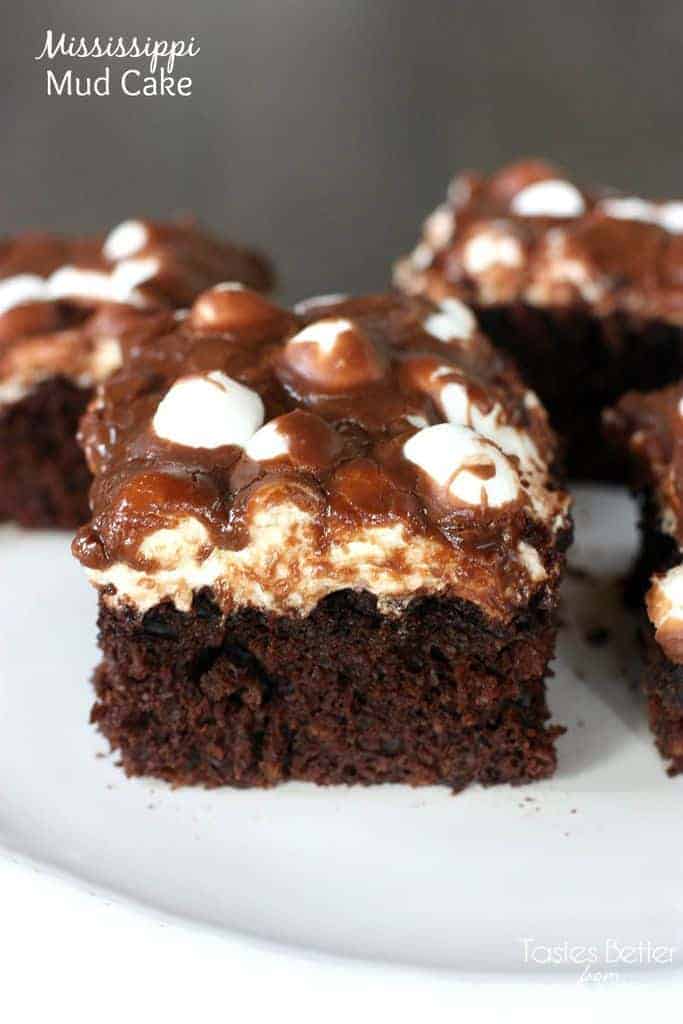
A picture of the Mississippi Mud Cake.
Image selected by Emily and located at Tastes Better from Scratch!
Rolo Cake was a big hit and it’s so easy to make. It’s just chocolate cake with caramel frosting with a drizzle of melted caramel and melted semi-sweet chocolate on top. However be sure to separate icing evenly across the cake. With my limited time my icing spread a little too thick in some places. Also I suggest, if you aren’t much of a sweet tooth, to just generously drizzle the icing.

Last Wednesday I made Mississippi Mud Cake. Everyone loved it. Mississippi Mud Cake is a chocolate cake with marshmallows on top and a chocolate ganache icing generously drizzled on top. This dessert was almost a "fail" because once I started cutting the first pan into squares it looked horrible. I think the icing needed to set more. However, even though it didn’t look the best it still tasted great.

I have a couple suggestions for this recipe. One: don’t over toast the marshmallows. You want them to puff together but not turn brown. Two: if you do wish to cut the cake, dip the knife into hot water with each cut. Three: be generous with the icing, I find it really compliments the cake. Four: use a very moist chocolate cake recipe. When the cake goes into the oven a second time, it drys out a little. And five: a scoop of vanilla ice-cream would suit this cake perfectly (although vanilla ice cream is good with just about everything).

A snapshot of the mouth-watering Rolo Cake.
Image located by Emily.
Rolo Cake
Moist Chocolate Cake
Yields one small sheet pan

- 2 cups Flour
- 2 cups Sugar
- 3/4 cups Cocoa powder
- 2 tsp. Baking Soda
- 1 tsp. Baking powder
- 1 tsp. Salt
- 1 cup Oil or Butter (I use butter)
- 1 tsp. Vanilla Extract
- 2 Eggs
- 1 cup Coffee, brewed at room temp.
- 1 cup Milk

In the mixer combine all dry ingredients. Then beat in eggs, vanilla and and oil. Slowly add coffee and milk to the mixture. Lastly pour into the sprayed and prepared pan. Bake at 375 for 20-25 minutes.

Caramel Frosting:
http://www.pauladeen.com/caramel-frosting

Mississippi Mud Cake:
http://tastesbetterfromscratch.com/2015/09/mississippi-mud-cake.html